Research
Overview
The Jackson Lab models electronic processes (e.g. reactivity, conductivity, optical properties) in soft materials (e.g. polymers, liquid crystals, glasses) using AI and molecular modeling. There is a strong effort devoted to method developments that enable electronic predictions in disordered systems using physics-based modeling and AI.
Two good introductions to the broad themes and interests of the group can be found here:
- A Quantum Mechanical Frontier for Polymer Science. Kavli Emerging Leader in Chemistry Lecture at ACS Spring Meeting 2025.
- Perspective Article: Wang, C.-I.; Jackson, N.E.* Bringing Quantum Mechanics to Coarse-Grained Soft Materials Modeling. Chem. Mater. 2023, 35, 4, 1470-1486.
Electronic Coarse-Graining: Quantum Mechanics Beyond Atomic Resolution

Description:
Nearly every method in quantum chemistry inherits a single assumption — that all atomic positions must be specified before anything can be said about the electrons. That requirement is why simulating even a nanometer chunk of a plastic solar cell or a battery electrode can consume a supercomputer, and why materials whose usefulness depends on quantum mechanical behavior remain difficult to design rather than discover by trial and error. Our group is developing a different approach called Electronic Coarse-Graining, in which the electronic behavior of a material is predicted directly from a simplified, lower-resolution description that leaves out most of the atomic detail to make calculations dramatically cheaper. Building these methods requires integrating ideas from quantum mechanics, statistical mechanics, and machine learning. If successful, calculations that are currently impossible become routine, opening up the design of soft electronic materials at the length scales where they actually operate.
AI for Soft Materials
Description:
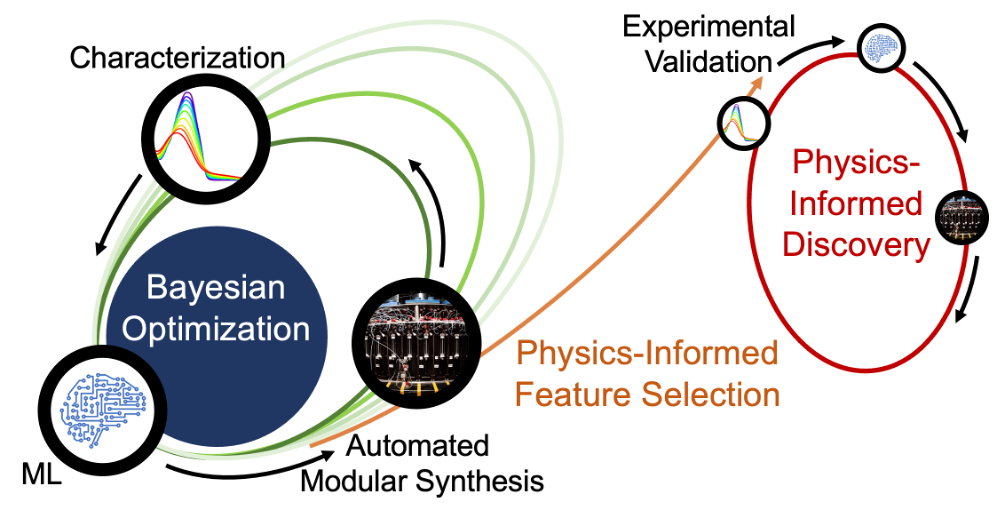
Artificial intelligence has reshaped fields where data are plentiful and the goal is easy to state. Soft materials chemistry is neither: the molecules are large, defective, and flexible, the properties we care about emerge only from collective behavior, and the space of possible chemistries is enormous but constrained by what a chemist can actually synthesize. We develop both forward and inverse AI approaches designed around those realities. In the forward direction, we build models that predict complex behavior from molecular structure. In the inverse direction, we work backward from a desired property to the molecules that could deliver it, searching not the space of everything imaginable but the smaller space of what is actually reachable through known chemistry from available starting materials. Together these efforts aim to shorten the path from an idea for a soft material to a specific chemical reaction worth performing.
Multiscale Modeling of Soft Electronic Materials
Description:
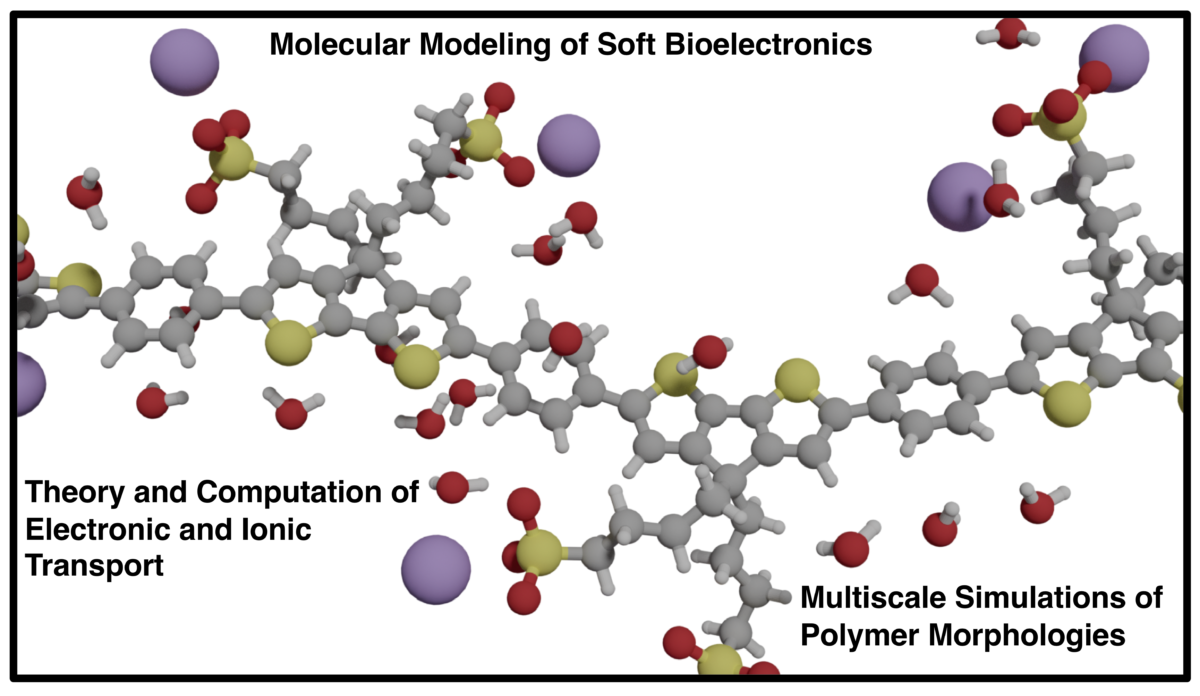
Plastic electronics are unusual among electronic materials in that they carry both electrons and ions, and they do so in a soft, disordered environment that is highly malleable. Their performance hinges on doping: blending in a molecular or ionic additive that exchanges an electron with the polymer and leaves behind a counterion that must find somewhere to sit. That single step couples chemistry, conformation, morphology, and electrostatics, which is why doping efficiency is still largely tuned by trial and error rather than predicted. Our group develops simulation methods that treat doping as a reactive, thermodynamic process rather than a fixed input, allowing charge transfer and the surrounding polymer to respond to one another, and that propagate electronic structure up to the length scales where real films operate. The goal is a predictive link running from monomer chemistry to device-level conductivity.
Computational Resources
We benefit from the many computational resources on campus. Primarily, we use our private group cluster, “scruggs”, and the community cluster, lop, run out of the School of Chemical Sciences. If further resources are required, we utilize NCSA clusters Delta and Hal or resources nearby at Argonne National Laboratory.
Funding
We are very thankful for generous support from the following research sponsors.